About the Artist
Nancy Rourke is an internationally recognized Deaf artist whose work explores Deaf culture, history, identity, human rights, and social justice. Through bold color, symbolism, and visual storytelling, she has become one of the leading contemporary voices in Deaf art.
Born deaf, Rourke’s deafness was not identified until she was six years old. During those early years, drawing and painting became her primary means of communication with her hearing parents, who did not know sign language. She attended a Deaf oral education program in San Diego, where art became both a refuge and a powerful form of self-expression.
From childhood through high school, Rourke continuously created artwork, exhibiting everything from painted rocks to canvases at art fairs, competitions, and galleries. She later studied graphic design and painting at the National Technical Institute for the Deaf and the Rochester Institute of Technology in New York, where she earned a master’s degree in computer graphic design and painting.
In 1979, Rourke participated in her first exhibition at the National Gallery of Art in Washington, D.C. Soon afterward, she was selected as one of twelve Deaf artists featured in Heart, Eye, Hand at the renowned Ankrum Gallery in Los Angeles. The gallery was owned by Joan Ankrum, aunt of celebrated Deaf artist Morris Broderson.
Despite these early achievements, Rourke stepped away from painting. Unsure whether she could build a successful career in the art world, she pursued professional opportunities in graphic design.
For more than twenty years, she worked in the technology and entertainment industries. At Xerox in San Diego, she served as a graphic designer. Later, at 20th Century Fox, she worked as a color palette designer, creating color schemes for the colorization of classic black-and-white films, including Casablanca, King Kong, Sherlock Holmes, and numerous John Wayne films. In 1991, she moved to Seattle and joined Microsoft, where she designed icons for the Windows operating system.
After an unexpected layoff, Rourke returned to painting. Following additional artistic training and workshops, she spent nearly a decade painting portraits, landscapes, cityscapes, and still lifes. In 2010, she experienced a pivotal transformation in her artistic direction, dedicating her work exclusively to Deaf culture, Deaf history, and the Deaf experience. In doing so, she discovered her true artistic purpose.
Today, Rourke’s paintings are collected, exhibited, and studied internationally for their powerful visual advocacy and their contributions to contemporary Deaf culture and social justice discourse.
Artist Statement
My work centers on themes of resistance, affirmation, and liberation within the Deaf experience. Through symbolism, color, and visual narrative, I explore the social, political, and cultural realities that have shaped Deaf lives across history and continue to influence our communities today.
Recurring motifs in my paintings include blue tape, yellow lights, hands, eyes, elephants, horses, strings, cracks, and bandages. These symbols serve as visual metaphors that communicate ideas about language, identity, oppression, resilience, and empowerment. I primarily work with bold primary colors, often reinforced with monochromatic passages that intensify their visual and emotional impact.
My paintings function as both artistic expression and social commentary. They address issues of human rights, social justice, artivism, and collective solidarity. I seek to illuminate subjects that have often been ignored, misunderstood, or hidden from public view.
Influenced by artists such as Jean-Michel Basquiat and Jacob Lawrence, whose work examined race, identity, and civil rights, I use painting to examine the Deaf experience through a similar lens. My resistance works address oralism, linguistic oppression, mainstreaming, communication barriers, paternalism, colonialism, audism, and contemporary issues such as genetic engineering and attempts to eliminate deafness. These works expose what I call the “mask of benevolence”—systems and institutions that claim to help Deaf people while simultaneously denying Deaf autonomy and cultural identity.
My affirmation works celebrate American Sign Language, Deaf culture, Deaf history, Deafhood, self-acceptance, empowerment, and community pride. My liberation works unite resistance and affirmation, depicting the journey from oppression toward self-determination and cultural empowerment.
Throughout history, Deaf people have been subjected to discrimination, exclusion, and control by predominantly audist societies. For centuries, misconceptions about deafness have persisted, dating back to Aristotle’s assertion that deaf people were incapable of reason. Through my work, I seek to challenge those narratives, reveal their lasting consequences, and affirm the humanity, dignity, and rights of Deaf people.
My goal is not only to educate audiences but also to inspire dialogue, reflection, and social change.
Artistic Process
My artistic practice is influenced by both the Fauvist and Neo-Expressionist movements. I am drawn to their bold use of color, emotional intensity, and expressive mark-making.
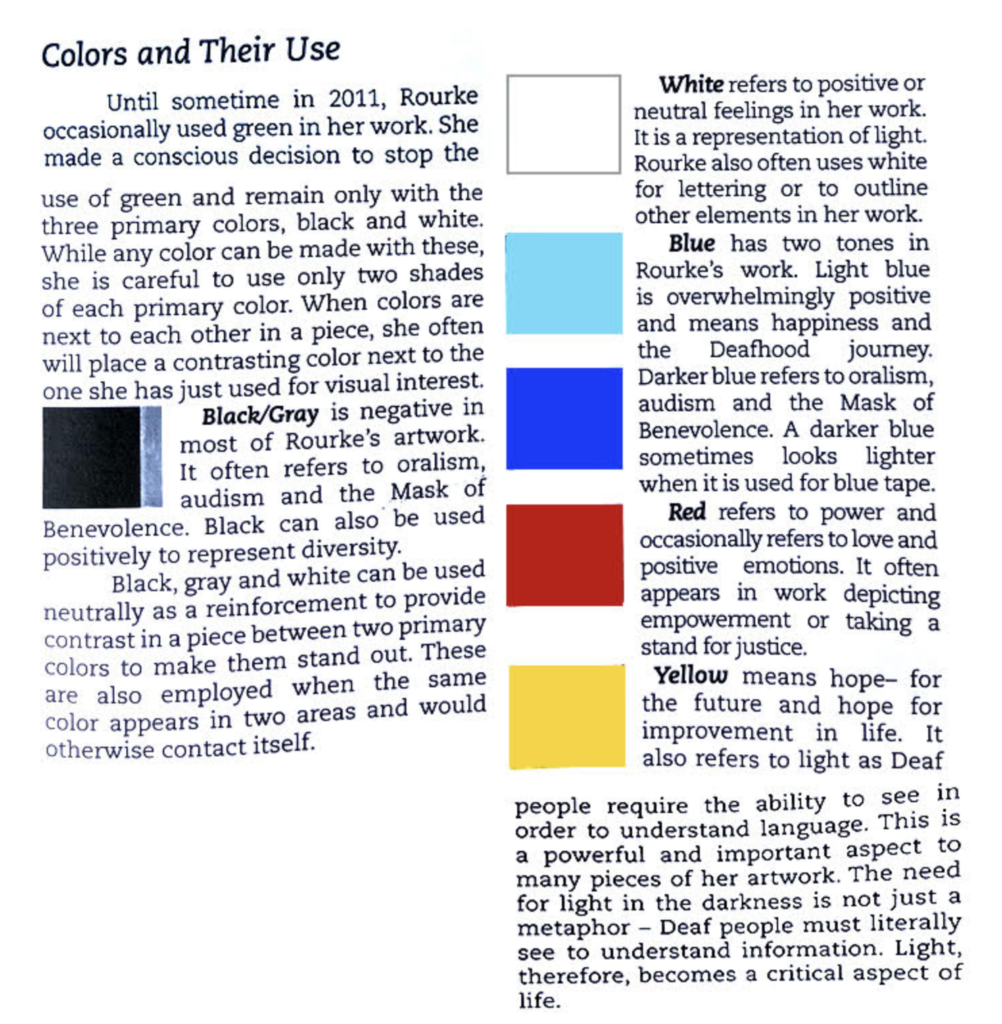
I work primarily with highly saturated colors, often incorporating monochromatic passages to strengthen visual contrast and emotional impact. I use primary colours that have come to be identified with my work and are now referred to as Rourkeism. Each colour has a meaning behind it. Red refers to empowerment or taking a stand for justice. Yellow means hope for the future and improvement for life. It also refers to light as Deaf people need the ability to see to understand information. Blue has two tones in my work. Light blue means happiness and the Deafhood journey. Darker blue refers to Audism, oralism and discrimination. Black and white colours are used as stylistic reinforcement to make the primary colours pop. I limit myself to using only a few colours. My paintings feature energetic brushwork ranging from thick to thin, short to long, and controlled to spontaneous.
I frequently employ direct painting techniques, applying opaque color in a single application and generally working from light values toward darker ones.
A significant part of my process involves scrubbing paint across the surface in multiple directions to create movement and texture. I also utilize scumbling, a technique in which an almost dry brush lightly applies opaque paint over an existing layer, softening and enriching color relationships while preserving the vitality of the underlying surface.
Through these methods, I strive to create paintings that are visually powerful, emotionally immediate, and deeply connected to the lived experiences of Deaf people.