
Deaf History
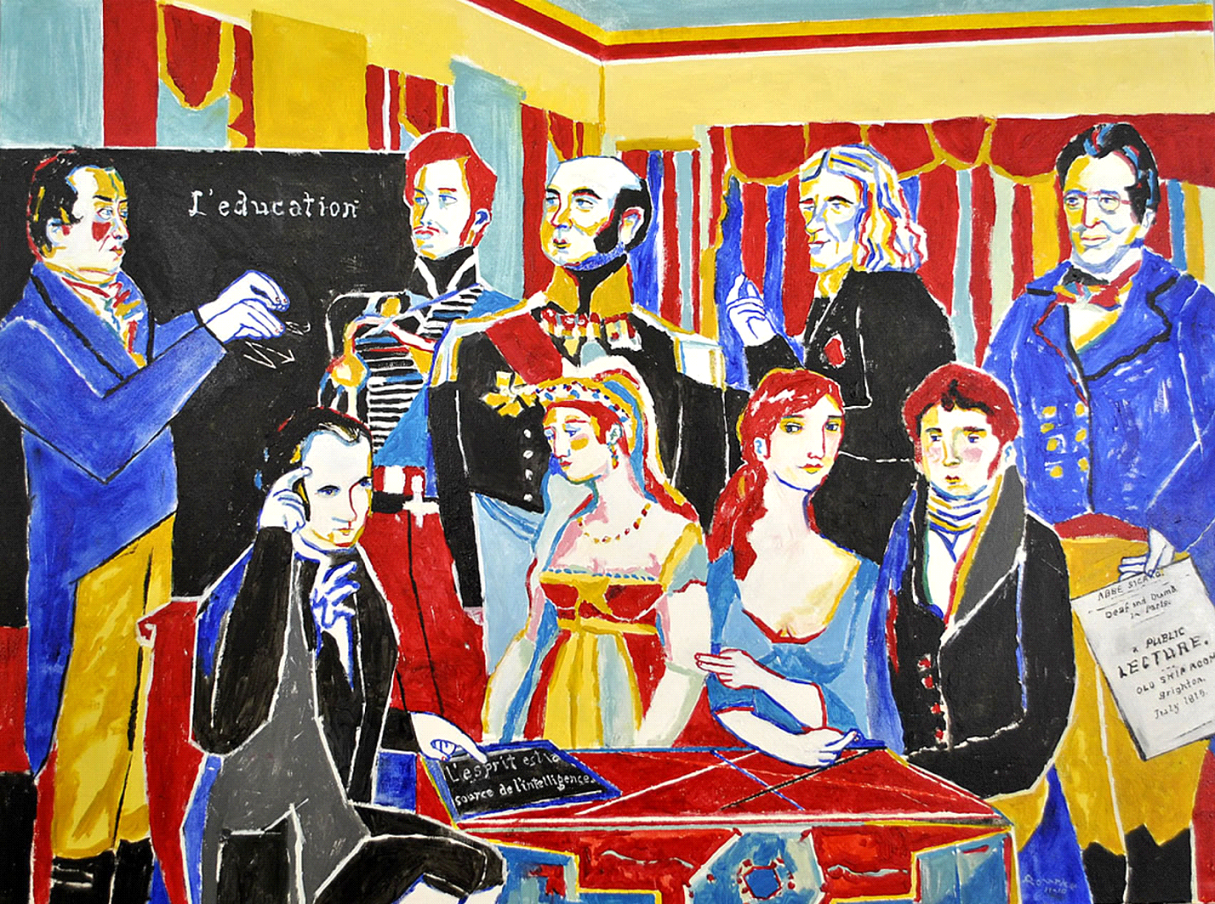
The Public Lecture, 1815.
30 x 40 inches
Oil on Canvas
November 2010
SOLD
This painting recreates one of the most significant moments in Deaf history—the Public Lectures held during the summer of 1815 in the Argyle Room at the Old Ship Rooms in Brighton, England. Although these individuals were not all present at the same lecture, I chose to bring them together in one composition to represent the importance of these historic events.
The nine figures in the painting are Abbé Roch-Ambroise Sicard (with long white hair), Jean Massieu (seated in a red chair holding a slate and signing Mind), Laurent Clerc (signing L’éducation), Armand Godard (the young man seated at the far right of the table), the Duke of Orléans (standing beside Clerc), the Duke of Kent (bald and standing beside the Duke of Orléans), the Duchess of Wellington (seated beside Massieu), Thomas Hopkins Gallaudet (holding a lecture leaflet), and a mysterious woman seated beside Godard.
The leaflet in Gallaudet’s hand is based on the actual lecture leaflet preserved at the American School for the Deaf Museum in Hartford, Connecticut. Gallaudet discovered the leaflet while he was in England to meet the Braidwood family, who dominated deaf education there through their oral method of instruction. Unaware that Sicard, Massieu, Clerc, and Godard were giving public demonstrations nearby, Gallaudet attended one of the lectures out of curiosity. It was there that he met Laurent Clerc for the first time.
The signs shown throughout the painting are based on Old French Sign Language (OFSL). To ensure historical accuracy, I consulted several experts and ultimately worked with six individuals to verify the correct signs. I also studied Lambert’s 1865 illustrations of Old French Sign Language, which became an invaluable resource during my research. The mysterious woman is shown using two French fingerspelled words, inviting viewers to wonder: What do they spell, and who is she?
England at the time strongly supported oralism through the influence of the Braidwood family. The French manual method of educating deaf students was largely unfamiliar to the British public. These public lectures introduced audiences to a completely different approach to deaf education.
The audience consisted of members of Parliament, the nobility, clergy, and the general public. They were astonished by the accomplishments of the “deaf-mutes,” witnessing their ability to read, write, reason, and respond thoughtfully to questions. On the chalkboard and slate are the written answers of Laurent Clerc and Jean Massieu. Clerc’s response concerns Education, while Massieu’s states, “Mind is the source of intellect,” both written in French.
The meeting between Gallaudet and Sicard proved to be a turning point in history. Following the lectures, Sicard invited Gallaudet to travel to Paris to study the French manual method of deaf education and French Sign Language. That journey ultimately led Gallaudet to invite Laurent Clerc to America, laying the foundation for American deaf education. In many ways, these Public Lectures became the milestone that made this history possible. Had Gallaudet never met Sicard, he would never have met Clerc, and the course of Deaf education in America might have been very different.
During my research, I discovered another fascinating historical detail. While attending one of the Public Lectures, the Duchess of Wellington received the news that her husband, the Duke of Wellington, had defeated Napoleon at the Battle of Waterloo.
This painting required eight weeks to complete. Most of that time was devoted to historical research, locating references, studying period clothing, architecture, and Old French Sign Language. Once the research was complete, the painting itself came naturally. I enjoyed every moment of creating it. As I painted, I imagined myself sitting among the audience, witnessing this extraordinary event firsthand.
The composition was inspired by the American artist John Smibert’s Bermuda Group, adapting its formal group portrait style to commemorate a defining moment in Deaf history.
The Public Lecture, 1815 represents one of the most pivotal events in Deaf history—a gathering that helped shape the future of Deaf education in America and forever changed the lives of generations of Deaf people.
Reviews
There are no reviews yet.